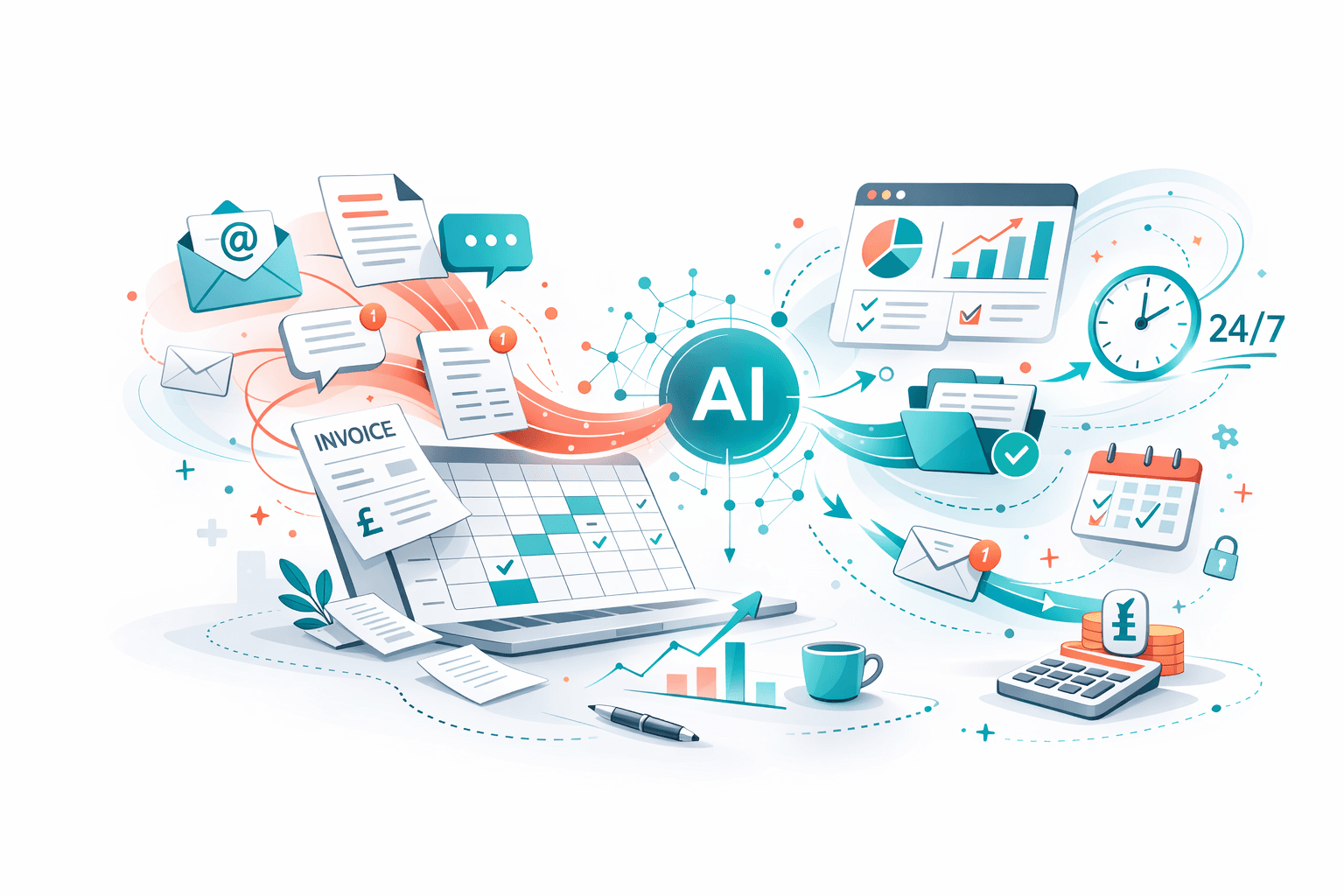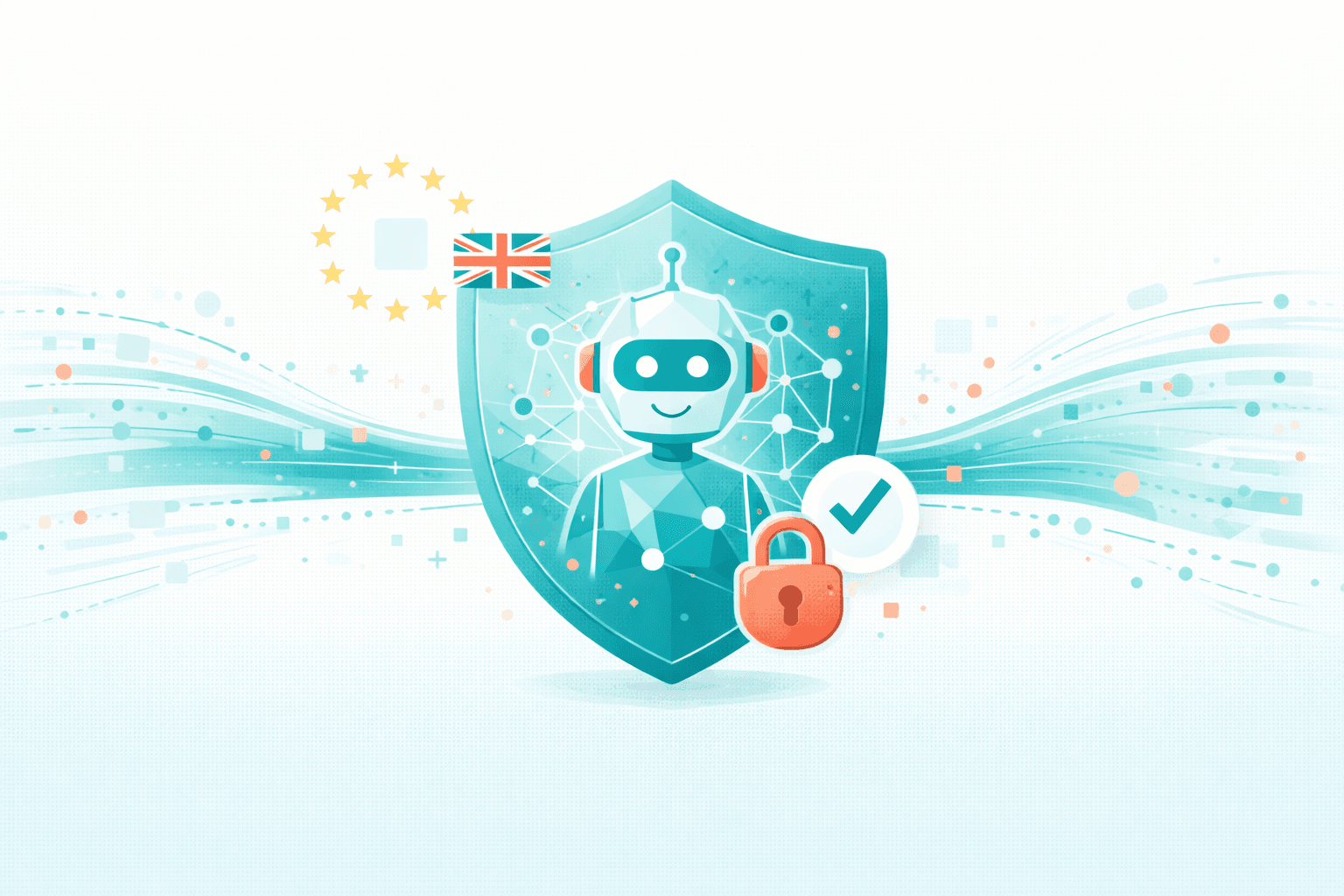
Is AI Safe for My Small Business? Data Security and GDPR Explained
You've heard about AI tools that could save you hours every week. The productivity benefits sound compelling. But then the doubts creep in.
What happens to your customer data? Is this even legal under GDPR? What if something goes wrong? Could you accidentally expose sensitive information?
These concerns are legitimate. As a small business owner, you're responsible for protecting customer data—and the consequences of getting it wrong range from regulatory fines to destroyed trust.
But here's the good news: using AI safely isn't complicated. This guide explains what you actually need to know, cutting through the jargon to give you clear, practical guidance for using AI with confidence.
The Short Answer: Yes, AI Can Be Safe
Let's start with the headline. AI tools can absolutely be used safely by UK small businesses, provided you:
- Choose reputable providers with appropriate security measures
- Understand what data you're sharing and why
- Have proper agreements in place
- Follow basic data protection principles you likely already apply
Most established AI platforms designed for business use take security seriously. They encrypt data, limit access, and comply with relevant regulations. The risks are manageable and the benefits are real.
That said, "can be safe" doesn't mean "automatically safe." Informed choices matter. Let's dig into what you need to know.
Understanding What AI Tools Actually Do With Your Data
Before assessing risk, understand what's happening when you use AI tools.
Data Input
When you use AI—whether it's an AI Worker handling customer enquiries, a chatbot on your website, or an AI assistant helping with tasks—you're providing data. This might include:
- Customer messages and enquiries
- Business information (services, pricing, policies)
- Documents you upload or reference
- Conversation history
Data Processing
The AI processes this input to generate useful outputs—responses to customers, summaries, recommendations, or completed tasks. This processing typically happens on the AI provider's servers, not your computer.
Data Storage
Some AI tools store data to:
- Maintain conversation context
- Learn and improve over time
- Provide history and records
- Enable features that require memory
Others process data without retaining it beyond the immediate interaction.
The Key Questions
When evaluating any AI tool, ask:
- What data does it access or receive?
- Where is that data processed and stored?
- How long is it retained?
- Who else can access it?
- What security measures protect it?
Reputable providers answer these questions clearly. If a provider can't or won't answer, that's a red flag.
GDPR: What It Actually Requires
GDPR gets mentioned constantly but is often misunderstood. Here's what it actually means for using AI in your business.
The Basics
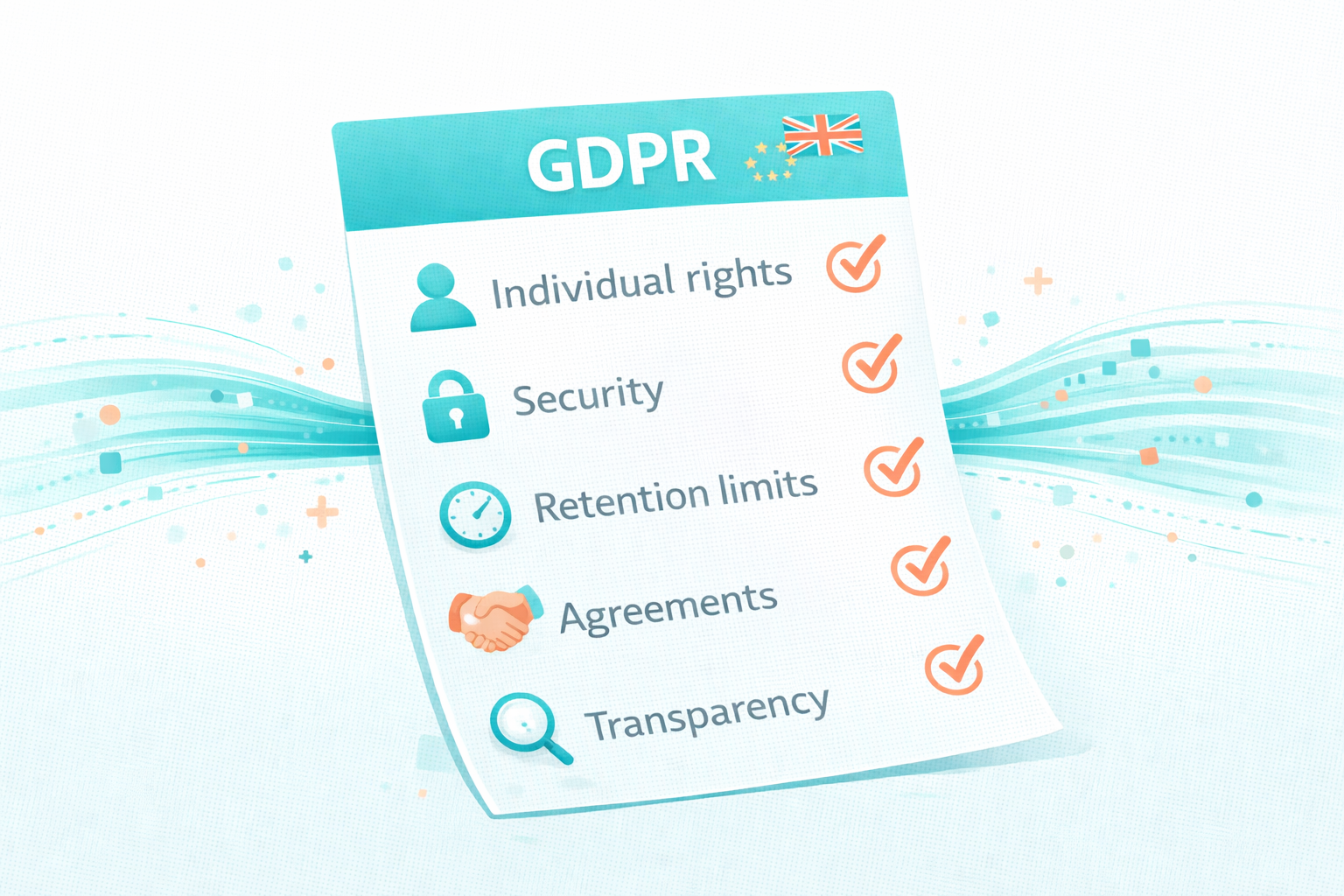
GDPR (General Data Protection Regulation) governs how organisations handle personal data of EU and UK residents. The UK has its own version (UK GDPR) that's essentially identical in requirements.
Personal data means any information relating to an identifiable person: names, email addresses, phone numbers, but also IP addresses, customer preferences, and conversation content.
Your Responsibilities
Under GDPR, you are a "data controller"—you decide what personal data to collect and what to do with it. When you use an AI service that processes personal data on your behalf, that AI provider becomes a "data processor".
Your obligations include:
- Having a lawful basis for processing data
- Being transparent about how you use data
- Keeping data secure
- Only keeping data as long as necessary
- Responding to individual rights requests
- Having appropriate agreements with processors
Lawful Basis for AI Processing
You need a lawful basis to process personal data. For most small business AI use, this is typically:
Legitimate interests: You have a legitimate business interest in efficient customer communication, and AI processing serves that interest without overriding individual rights. This works for most routine business AI use.
Contract performance: If AI helps you deliver services someone has contracted for, processing their data may be necessary for contract performance.
Consent: In some cases, you might obtain explicit consent for AI processing. This creates stronger protection but isn't always necessary or practical.
Data Processing Agreements
When using AI tools that process personal data, you should have a Data Processing Agreement (DPA) with the provider. This contract specifies:
- What data is processed
- How it's protected
- What happens when the relationship ends
- Each party's responsibilities
Good news: reputable AI providers offer standard DPAs as part of their terms. You don't need to negotiate custom contracts—just ensure one exists and covers the essentials.
What GDPR Doesn't Require
GDPR doesn't prohibit using AI. It doesn't require you to avoid cloud services or keep all data on your own computers. It doesn't demand perfection—it requires reasonable, appropriate measures.
Small businesses aren't expected to have enterprise-grade security teams. You're expected to make sensible choices appropriate to your scale and the data you handle.
Data Security: What to Look For
When evaluating AI tools, certain security features indicate serious providers.
Encryption
In transit: Data should be encrypted when travelling between your devices and the AI provider's servers. Look for HTTPS connections and TLS encryption. This is standard practice—any reputable service offers this.
At rest: Data stored on servers should also be encrypted, so even if someone accessed the storage, they couldn't read the data. Ask whether data-at-rest encryption is implemented.
Access Controls
Who can access your data within the provider's organisation? Good practices include:
- Role-based access (only relevant staff can access)
- Audit logs (access is tracked)
- Principle of least privilege (minimal access granted)
Data Residency
Where are servers located? For UK businesses, data stored in the UK or EU/EEA provides strongest legal protection. Data stored in the US may be acceptable under appropriate frameworks, but adds complexity.
Ask providers where your data will be processed and stored. Clear answers are a good sign.
Security Certifications
Look for recognised certifications:
ISO 27001: International standard for information security management. Indicates systematic security practices.
SOC 2: Service Organisation Control report demonstrating security controls. Common for US-based providers.
Cyber Essentials: UK government-backed certification for basic cyber security measures.
Certifications aren't guarantees, but they indicate serious attention to security.
Incident Response
What happens if something goes wrong? Providers should have:
- Security incident procedures
- Breach notification processes
- Regular security testing
- Vulnerability management
Practical Risk Assessment
Different AI use cases carry different risk levels. Assess yours realistically.
Lower Risk Uses
General customer enquiries: Questions about your services, opening hours, pricing—information that's largely public anyway. Limited personal data involved.
Scheduling and booking: Names, contact details, and appointment times. Personal but not sensitive. Standard business data handling.
Content generation: Creating marketing content, drafting emails, or summarising documents that don't contain sensitive personal information.
Moderate Risk Uses
Customer service conversations: May involve personal circumstances, complaints, or account details. Requires appropriate security but manageable.
Invoice and payment processing: Financial information requires careful handling but is routine for business.
Employee-related uses: HR processes, scheduling, or communication involving employee data. Warrants attention to internal policies.
Higher Risk Uses
Health or medical information: Subject to special category data rules. Extra care required.
Financial advice or detailed financial data: Regulatory considerations beyond GDPR may apply.
Legal matters: Privilege and confidentiality concerns. Careful evaluation needed.
Children's data: GDPR provides extra protection for children's information. Special attention required.
For most small businesses, AI use falls into lower or moderate risk categories. Standard good practices provide adequate protection.
Questions to Ask AI Providers
Before committing to any AI tool, get clear answers to these questions.
Data Handling
- What data do you collect and process?
- Where is data stored geographically?
- How long do you retain data?
- Can I delete my data, and how?
- Do you use my data to train AI models?
Security
- What encryption do you use (in transit and at rest)?
- What security certifications do you hold?
- How do you handle security incidents?
- What access controls protect my data?
Compliance
- Do you offer a Data Processing Agreement?
- How do you support GDPR compliance?
- Can you help me respond to data subject requests?
- What happens to my data if you cease operating?
Practical Matters
- Do you have UK-based support?
- What's your uptime track record?
- How do you handle service disruptions?
Red flags include vague answers, inability to provide a DPA, and reluctance to discuss security specifics.
Setting Up AI Safely: A Checklist
Use this checklist when implementing AI tools in your business.
Before You Start
☐ Identify what personal data the AI will access ☐ Confirm you have lawful basis for this processing ☐ Review the provider's privacy policy and terms ☐ Sign or accept a Data Processing Agreement ☐ Verify data storage location meets your requirements ☐ Check security certifications or practices
During Setup
☐ Use strong, unique passwords for AI tool accounts ☐ Enable two-factor authentication if available ☐ Limit access to team members who need it ☐ Configure data retention settings appropriately ☐ Test with non-sensitive data initially
Ongoing Operations
☐ Review AI tool access periodically ☐ Update your privacy policy to reflect AI use ☐ Monitor for unusual activity or issues ☐ Keep software and integrations updated ☐ Document your AI processing activities
If Things Change
☐ Reassess when adding new AI capabilities ☐ Review when AI providers update their terms ☐ Update documentation when processes change ☐ Remove access promptly when staff leave
Updating Your Privacy Policy
If you're using AI to process customer data, your privacy policy should reflect this. You don't need complex legal language—clear, honest communication works best.
What to Include
What you're doing: Explain that you use AI tools to help manage customer communication, bookings, or whatever applies.
What data is involved: Specify what types of information the AI processes—enquiry content, contact details, booking information.
Why you're doing it: Your legitimate interest in efficient service delivery, improved response times, or better customer experience.
Who processes the data: You can mention using third-party AI services without necessarily naming specific providers (though you can if you prefer).
Data protection: Assure customers that appropriate security measures are in place and data is handled in accordance with GDPR.
Example Language
"We use AI-powered tools to help us respond to customer enquiries quickly and manage bookings efficiently. When you contact us, an AI assistant may handle your initial enquiry, collecting relevant details so we can help you effectively. This information is processed securely by our service providers in accordance with our data protection obligations. You can always request human assistance if you prefer."
Keep it simple. Customers want reassurance, not legal essays.
Common Concerns Addressed

"What if AI makes a mistake with customer data?"
AI mistakes are typically content errors (wrong information given) rather than data breaches. Handle them as you would any customer service error: acknowledge, correct, and apologise if needed.
For actual data incidents (unauthorised access, data loss), follow your incident response procedure. GDPR requires notifying the ICO within 72 hours for significant breaches.
The risk of AI-caused data breaches isn't higher than other business software. Standard security practices protect you.
"Could I be fined for using AI?"
GDPR fines are for serious violations—systemic failures to protect data, ignoring individual rights, or reckless handling of sensitive information. Using a reputable AI tool with appropriate agreements isn't a violation.
The ICO (Information Commissioner's Office) focuses enforcement on serious harm and deliberate non-compliance. Small businesses making good-faith efforts to comply rarely face penalties.
"Do I need to tell customers I'm using AI?"
GDPR requires transparency about how you process personal data. If AI handles customer data, your privacy policy should reflect this (see above).
Whether to proactively tell customers "you're talking to AI" is a separate question. There's no legal requirement for general customer service AI, though some contexts (like automated decision-making with legal effects) have specific rules.
Many businesses take a transparent approach because customers appreciate honesty, not because it's legally required.
"What about AI and automated decision-making?"
GDPR provides special rights regarding "solely automated decision-making with legal or significant effects." This means decisions made entirely by AI that significantly affect someone—like automatic loan rejections or job application filtering.
Most small business AI use doesn't trigger these rules because:
- Humans remain in the loop for significant decisions
- The decisions don't have legal or similarly significant effects
- There's easy access to human review
If your AI is making significant decisions about people without human involvement, you need to ensure appropriate safeguards. For routine business automation, this isn't a concern.
"Is it safer to keep everything on my own computer?"
Not necessarily. Established cloud providers typically have better security than local small business setups. They employ security professionals, maintain updated systems, and implement sophisticated protection.
Your laptop getting stolen or infected with ransomware may pose greater risk than a reputable cloud AI service.
The question isn't cloud versus local—it's whether appropriate security measures exist wherever data lives.
"What if the AI provider gets hacked?"
Choose providers with strong security practices, incident response procedures, and breach notification commitments. This minimises risk and ensures you'll be informed if incidents occur.
If a breach does happen, the provider should notify you promptly. You then assess impact on your customers' data and take appropriate action, including ICO notification if required.
This risk exists with any service provider—your email provider, accounting software, or payment processor could also be targeted. AI doesn't create unique vulnerability.
AI Safety Best Practices
Beyond compliance requirements, these practices keep your AI use secure.
Minimise Data Sharing
Only provide AI tools with data they need. If the AI doesn't need customer surnames to answer enquiries, don't include them. Less data shared means less data at risk.
Regular Review
Periodically review what AI tools you're using and what data they access. Remove unused integrations. Update access when roles change.
Stay Informed
AI capabilities and regulations evolve. Stay aware of:
- Updates from your AI providers
- ICO guidance on AI
- Industry best practices
You don't need to become an expert, but basic awareness helps you make good decisions.
Have a Plan
Know what you'd do if something went wrong. Who would you contact? What steps would you take? Even a simple plan beats improvising during a crisis.
Document Appropriately
Keep basic records of:
- What AI tools you use
- What data they process
- What agreements are in place
- When you last reviewed arrangements
This documentation helps if questions arise and demonstrates good practice.
The Bottom Line on AI Safety
Using AI in your small business is not inherently risky. Millions of businesses use AI tools safely every day. The technology is mature, regulations are clear, and good providers take security seriously.
Your job is to make informed choices:
- Choose reputable providers
- Understand what data you're sharing
- Have appropriate agreements in place
- Follow basic security practices
- Be transparent with customers
These aren't onerous requirements. They're sensible business practices that apply to any technology you use.
Don't let fear of the unknown prevent you from benefiting from AI. The risks are manageable. The benefits are real. And with basic due diligence, you can use AI confidently, knowing you're protecting your business and your customers.
Frequently Asked Questions
Do I need special permission to use AI in my business?
No special permission is required to use AI tools for legitimate business purposes. You need to comply with data protection law (GDPR) when processing personal data, but this applies to all your business activities, not just AI. Choose reputable providers, have appropriate agreements in place, and follow standard data protection practices.
Is GDPR different for AI than for other software?
The same GDPR principles apply to AI as to any software processing personal data. You need lawful basis, appropriate security, transparency, and data processing agreements with providers. AI isn't treated specially—it's assessed like any other data processing activity.
What happens if my AI tool processes data incorrectly?
Content errors (AI gives wrong information) should be corrected and apologised for like any customer service mistake. Actual data protection incidents (unauthorised access, data loss) require assessment and potentially ICO notification. The response is the same as for any business system error.
Do I need to inform the ICO that I'm using AI?
No notification to the ICO is required simply for using AI tools. If you're already registered with the ICO (as most businesses processing personal data should be), you don't need to update your registration specifically for AI use. Your existing registration covers your processing activities.
Can I use AI tools based in the US?
Yes, but with attention to data transfer arrangements. Many US-based AI providers offer EU/UK data residency options. Others rely on approved transfer mechanisms like Standard Contractual Clauses. Check where your data will be processed and what safeguards exist for international transfers.
How do I respond if a customer asks about AI handling their data?
Be honest and reassuring. Explain that you use AI tools to improve response times and service quality, that appropriate security measures protect their data, and that humans oversee the process. Offer human assistance if they prefer. Most customers accept this when explained clearly.
What security certifications should I look for?
ISO 27001 is the most widely recognised information security certification. SOC 2 is common for US-based services. Cyber Essentials is a UK government-backed certification. Any of these indicates serious attention to security, though absence doesn't necessarily mean poor security—especially for newer companies.
Do I need a separate privacy policy for AI?
No separate policy is needed. Update your existing privacy policy to mention AI processing where relevant. Explain what you're doing, what data is involved, and how it's protected. A few clear sentences typically suffice.
What if I don't understand the technical security details?
You don't need deep technical expertise. Focus on practical indicators: Is the provider reputable? Do they offer a Data Processing Agreement? Can they explain their security practices in plain language? Do they have relevant certifications? These proxy measures help you assess security without needing to evaluate encryption algorithms.
Are free AI tools safe to use?
Free tools vary widely. Some free tiers of reputable services are perfectly safe—they're lead generators for paid plans. Others monetise through data, which may conflict with your data protection obligations. Read terms carefully, check what rights you're granting, and consider whether free is worth potential data risks. For business use, paid plans often provide clearer data protection commitments.

TheyWork Team
TheyWork gives small UK businesses an AI-powered worker that finds leads, writes content, responds to reviews, and handles admin — so you can focus on growing.
Ready to try an AI Worker?
Get your own AI worker that finds leads, writes content, and handles admin. Start free for 7 days.
Get startedMore from the blog
AI for Estate Agents: How UK Agencies Can Qualify Leads and Book More Viewings Without Hiring More Admin
A practical guide for UK estate agents on using AI to respond faster, qualify leads, and book more viewings while reducing admin workload and missed opportunities.

10 Signs Your Small Business Is Ready for an AI Worker
Not sure if AI is right for your business? Here are 10 clear signs that your small business is ready for an AI Worker—and would benefit from implementing one today.